Guides Frogs
FrogID Week: 6 to 15 November 2026
Frogs in your backyard
That racket after rain is frogs, and in a Perth garden it’s most likely the motorbike frog: a rising rev, like a motorbike changing gears. Record it with the free FrogID app, and leave them be. WA Museum FrogID
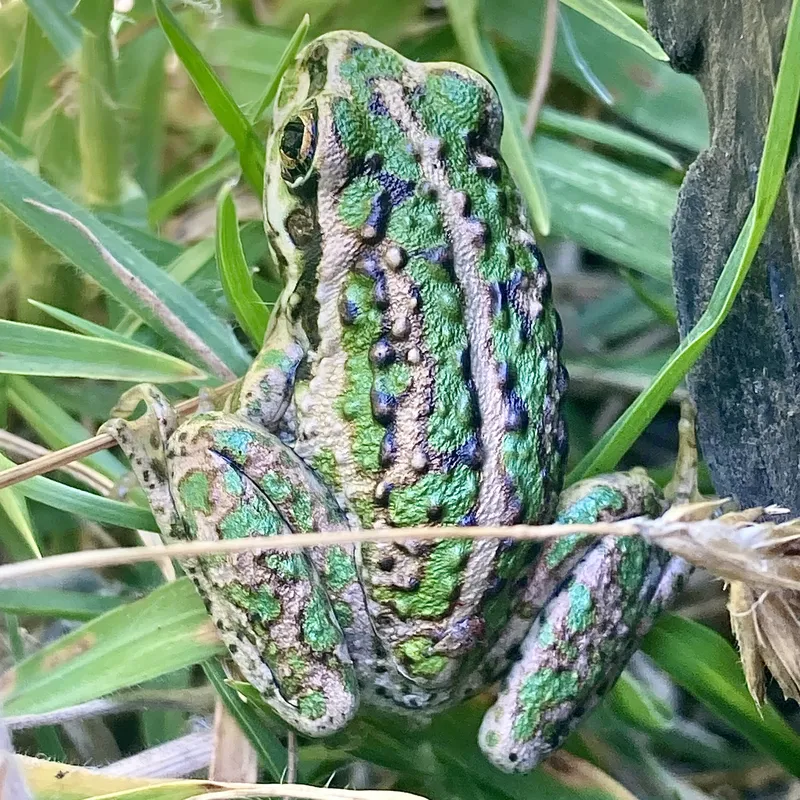
Frogs calling at night
change with the months. Winter is the big chorus; summer belongs to the motorbike frog. Here’s who calls when, in the south-west. FrogID
- Motorbike frog
- Western banjo frog
- Slender tree frog
- Moaning frog
- Squelching froglet
- Quacking frog
- Rattling froglet
- Turtle frog
- Crawling toadlet
Motorbike frog sound
and every other call in a south-west backyard, in the WA Museum’s own words. Scientists identify frogs the same way: by their calls. Perth Zoo
-
Motorbike frog
“A rising series of tones (similar to a motorbike changing gears, hence the common name), followed by a series of warbling growls.” WA Museum
The frog you’re most likely to meet in a Perth garden, and usually the first to move into a new backyard pond. Its tadpoles can skip turning into frogs in a deep, cool pond, grow as big as 14 cm, and stay tadpoles for 14 months. Up to 7.5 cm. WA Museum
-
Western banjo frog
“A single, explosive ‘bonk’ repeated at intervals and answered by other males.” WA Museum
The female beats the water into a white foam raft for her eggs, and that floating foam nest is unique among south-western frogs. Calls around Perth from July and August. WA Museum
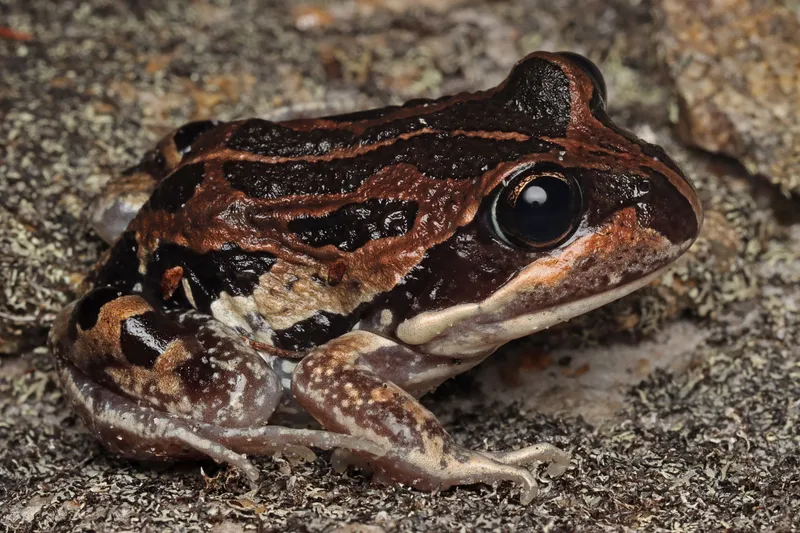
A western banjo frog near Albany. Photo: Connor Margetts, CC0, via iNaturalist. -
Slender tree frog
“A loud single grating ‘grrrk’, with higher-pitched calls occasionally interjected.” WA Museum
Found only in the south-west, with no close relatives anywhere else in Australia. Named after Adelaide by mistake: it doesn’t live there. WA Museum
-
Moaning frog
“A long, drawn out, mournful moan.” WA Museum
Calls from a burrow for a month or so after the first heavy autumn rains, often in gardens near wetlands, “sometimes to the dismay of the residents”. WA Museum
-
Squelching froglet
“A ‘squelch’ sound (‘like drawing a wet finger over a balloon’).” WA Museum
Only 2.5 cm, but a chorus of hundreds carries a long way. Common around Herdsman, Bibra and other big Swan Coastal Plain lakes. WA Museum
-
Quacking frog
“Similar to the sound of a duck quacking.” WA Museum
Males match the number of quacks a neighbour gives, and hiding males will quack back at a human. Mostly a forest and hills frog. WA Museum
-
Rattling froglet
“A metallic rattling or clicking sound … likened to the sound of a ‘pea in a can’.” WA Museum
One of the smallest frogs in the south-west, and unusual for calling by day in light rain. Commonest along the Darling Escarpment. WA Museum
-
Turtle frog
“Deep croaks, made from partway down a breeding burrow.” WA Museum
Looks like “a small turtle with its shell removed”, burrows head first, and skips the tadpole stage altogether: babies hatch as tiny frogs. Lives on sandy soils, such as Kings Park and Bold Park. WA Museum
-
Crawling toadlet
“A short, sharp, grating sound repeated frequently.” WA Museum
Calls from a shallow burrow under leaf litter from the first autumn rains. In Perth, recorded along the Swan, Canning and Murray rivers. WA Museum
Names keep changing: FrogID now calls the motorbike frog Ranoidea moorei and the slender tree frog Coggerdonia adelaidensis, where older guides say Litoria. Same frogs. FrogID
FrogID Week
runs Friday 6 to Sunday 15 November 2026. It’s Australia’s biggest frog count, and anyone with a smartphone can join in through the free FrogID app. FrogID
- 1.5 million
- Frogs verified through FrogID so far, across 232 species. FrogID
- 3,900
- Frogs recorded in 24 hours on 15 November 2025, nearly three a minute. FrogID
FrogID is run by the Australian Museum. We’re an independent site, not part of it.
- Get the app. FrogID is free. Users must be 13 or older, and for anyone under 18 a guardian accepts the terms, so kids record on a grown-up’s account. FrogID FrogID terms
- Go out after dark. Listen in the first few hours after dark, especially after rain. A garden, a pond or a local wetland all work. FrogID FrogID
- Record for at least 20 seconds. Keep the phone as still as you can, pointed at the call, and stay quiet: frogs may stop calling if they’re wary. No phone reception needed. FrogID
- Send it in. Every recording is listened to by frog call experts at the Australian Museum, and you hear back by email. It can take a few days to a few weeks. FrogID FrogID
- Don’t touch the frogs. FrogID’s pledge: watch where you tread, don’t touch frogs, and clean your shoes between frog spots so you don’t spread disease. FrogID
Frog pond
in the backyard? Build it, and wait: the frogs will come. In Perth, the motorbike frog is usually first to move in. FrogID WA Museum
Building one with the kids? It pairs well with our backyard activities for kids, and our nature scavenger hunt has a square for a frog calling after dark.
- Pick a quiet spot with filtered sun, shade and shelter, away from busy paths. Not too close to the house, either: frogs can be very noisy. Perth Zoo FrogID
- Shallow and deep. FrogID suggests at least 50 cm in the deepest part, with rocks and dirt so frogs can climb in and out. An old bath or a bog garden works too. FrogID Perth Zoo
- Rainwater is best. If you use tap water, Queensland’s government suggests letting it stand for 5 to 7 days first. Rinse a new pond before it goes in. Qld Government FrogID
- Plant it up. Rushes and sedges in the water, local natives around it, and logs, rocks and leaf litter for hiding. Don’t take logs or rocks from the bush: they may already be someone’s home. Perth Zoo
- No chemicals. Frogs drink and breathe through their skin. Perth Zoo says to avoid chemicals and non-organic fertilisers across the whole garden, and Waverley Council in NSW adds slug pellets to the list. Perth Zoo Waverley Council
- Fish? Only native ones. Western pygmy perch, western minnows or Swan River gobies eat mosquito larvae. Never goldfish or mosquito fish: they eat frog eggs. Perth Zoo
- Don’t add frogs or tadpoles. Let them find it themselves. FrogID
- Little kids about? ReWild Perth says ponds deeper than 30 cm need low fencing or strong mesh over the top. Check your council’s rules too. ReWild Perth
Can you move tadpoles
to your pond? No: don’t move frogs or tadpoles. FrogID’s advice is to let them arrive on their own. FrogID
The reason is chytrid, a fungus that attacks frogs’ skin and can kill them. It’s thought to be one of the main reasons four Australian frog species are now extinct, and it spreads by touching one frog and then another, or on boots and gear. FrogID
It’s already in south-west WA. DBCA says people spread it on footwear and equipment, and by illegally moving frogs from one area to another. DBCA
Cane toads in Perth
? Not living here: cane toads are in the Kimberley. But hitchhiker toads riding in vehicles have turned up as far south as Perth. So far every one reported has been caught. DBCA
Is it a cane toad?
- Big: adults up to 22 cm. Most native frogs are 2.5 to 10 cm.
- Dry, warty skin, a bony “m”-shaped ridge over the nose, and large poison glands on the shoulders.
- No suckers on the toes.
- The call: a long, steady trill, like a dial tone.
All from DBCA. DBCA
Think you’ve found one?
Don’t kill it. Many native frogs get mistaken for cane toads in the south-west, including the motorbike frog, western banjo frog, moaning frog and crawling toadlet. DBCA
Text a clear photo, and where you found it, to DBCA’s cane toad line on 0400 693 807, or email canetoads@dbca.wa.gov.au. DBCA DBCA If it’s calling, record it on FrogID too. FrogID
What frog sounds like a motorbike
? The motorbike frog, naturally. That and the other questions people search, each answered in its first line.
What frog sounds like a motorbike?
The motorbike frog. Its call is a rising series of tones, like a motorbike changing gears, then a run of warbling growls. It’s the frog most often found in Perth gardens. WA Museum
When is FrogID Week 2026?
Friday 6 to Sunday 15 November 2026. It’s the ninth FrogID Week, run by the Australian Museum through the free FrogID app. FrogID
Why are frogs so loud after rain?
Can I touch a frog?
Best not. Touching one frog and then another can spread chytrid fungus, and frogs’ sensitive skin readily absorbs chemicals, including from your hands. FrogID Qld Government
Sources, checked 13 October 2026
- Motorbike frog WA Museum FrogWatch (page says “Updated 1 decade ago”): the call; most commonly encountered frog in Perth suburban gardens, usually the first to colonise a new backyard pond; tadpoles to 14 cm, 14 months; length up to 7.5 cm
- Western banjo frog WA Museum FrogWatch: “A single, explosive ‘bonk’”; calling from July to August around Perth; floating foam nest unique among south-western frogs; spends much of the year buried in sandy soil
- Moaning frog WA Museum FrogWatch: “A long, drawn out, mournful moan”; calls for a month or so after the first heavy autumn rains; heard in gardens near wetlands “sometimes to the dismay of the residents”
- Slender tree frog WA Museum FrogWatch: “A loud single grating ‘grrrk’”; found only in the south-west, no close relatives elsewhere in Australia; “Named in error after Adelaide”
- Squelching froglet WA Museum FrogWatch: the “squelch” call, ‘like drawing a wet finger over a balloon’ (Bert Main); to 2.5 cm; choruses of hundreds; Herdsman, Parry, Piney and Bibra Lakes
- Quacking frog WA Museum FrogWatch: like a duck quacking; males mirror a neighbour’s number of quacks and respond to human quacks; low-lying moist areas within forests
- Rattling or clicking froglet WA Museum FrogWatch: a metallic rattling or clicking, a ‘pea in a can’ (Bert Main, 1965); one of the smallest in the south-west; calls by day in light rain; common along the Darling Escarpment
- Turtle frog WA Museum FrogWatch: “Deep croaks”; like “a small turtle with its shell removed”; burrows forwards; no tadpole stage; sandy soils, e.g. Kings Park and Bold Park
- Crawling toadlet WA Museum FrogWatch: “a short, sharp, grating sound repeated frequently”; breeds from the first autumn rains; recorded along the Swan, Canning and Murray rivers
- FrogID frog species pages Australian Museum: the month-by-month calling period on each species’ page (motorbike frog, western banjo frog, slender tree frog, moaning frog, squelching froglet, quacking frog, rattling froglet, turtle frog, crawling toadlet); current names Ranoidea moorei and Coggerdonia adelaidensis
- Frog-friendly garden Perth Zoo (updated 27 Jan 2026): around 30 frog species in the south-west, identified “by their calls”; pond location, bogs and soaks, shelter, plants; “Avoid using chemicals and (non-organic) fertilisers in and around your whole garden”; native fish only, not goldfish or Mosquito Fish
- FrogID Week Australian Museum: the ninth FrogID Week, Friday 6 to Sunday 15 November 2026; “Australia’s biggest frog count”; 3,900 frogs recorded in 24 hours on 15 November 2025
- How to FrogID Australian Museum, with the linked how-to guide (PDF, 2021): free app; record for at least 20 seconds; keep the phone still; be quiet; works without reception; listen after rain and in the first hours after dark; the pledge: don’t touch frogs, clean footwear between habitats
- FrogID FAQ Australian Museum: most frogs call at night, especially in the first few hours after dark, and are most active after rain; every recording checked by experts, in days to weeks; chytrid fungus spread by touching frogs and on boots, and linked to four extinctions; record calling cane toads
- FrogID Australian Museum home page counter, 13 Oct 2026: 1,523,749 verified frogs, 232 species
- FrogID terms of use Australian Museum (updated 31 Jul 2026), clause 1.1: users must be at least 13; for under-18s, a legal guardian accepts the terms
- Create a frog habitat Australian Museum FrogID poster (2026): not too close to houses (“frogs can be very noisy”); “a minimum of 50cm in the deepest parts”; rocks so frogs can get in and out; rinse a new pond; “Don’t introduce frogs or tadpoles into your new habitat. Sit back and relax; the frogs will come.”
- Design a native pond for wildlife ReWild Perth (with Perth councils): ponds deeper than 30 cm need access control such as low fencing or rigid mesh; check local council requirements
- Build a frog pond Queensland Government (updated 6 Aug 2026): rainwater ideally; chlorinated water to stand 5 to 7 days; “Avoid handling frogs. Frogs have sensitive skin and can readily absorb chemicals from anything they come into contact with, including your hands.”
- Management of commercial harvesting of flora in WA 2023–2028 DBCA (Mar 2023), pp 48–49: chytrid “is known to be present in south-west WA”; humans spread it “on contaminated footwear and equipment and by illegally moving frogs from one area to another”
- A frog-friendly garden Waverley Council, NSW (1 Sep 2025): “Cut out pesticide use including slug pellets”
- Don’t take a toad up the road DBCA Explore Parks: cane toads spread through the Kimberley since 2009; hitchhikers have reached Perth, and all reported have been collected; “If you find a suspected toad, DON’T KILL IT”; text 0400 693 807 or email canetoads@dbca.wa.gov.au
- Identifying cane toads DBCA: adults up to 22 cm, most native frogs 2.5 to 10 cm; dry warty skin; “m”-shaped ridge; shoulder glands; dial-tone trill; no toe suckers (poster, updated 5 Jan 2024); native frogs most mistaken for toads in the south-west; send a photo to 0400 693 807
We’re an independent site, not part of the Australian Museum, the WA Museum or DBCA, and nobody pays us to link anywhere on this page. The WA Museum’s frog pages carry no exact date (“Updated 1 decade ago”): we re-read each one on the date above.