Guides Bobtail
Out and about: as it warms up in early spring in the south-west, reptiles move around more
A bobtail in your yard?
Lucky you. Leave it be: it’s harmless, protected and finds its own food. Keep pets clear, and don’t feed it. DBCA Perth Zoo BC Act s 155
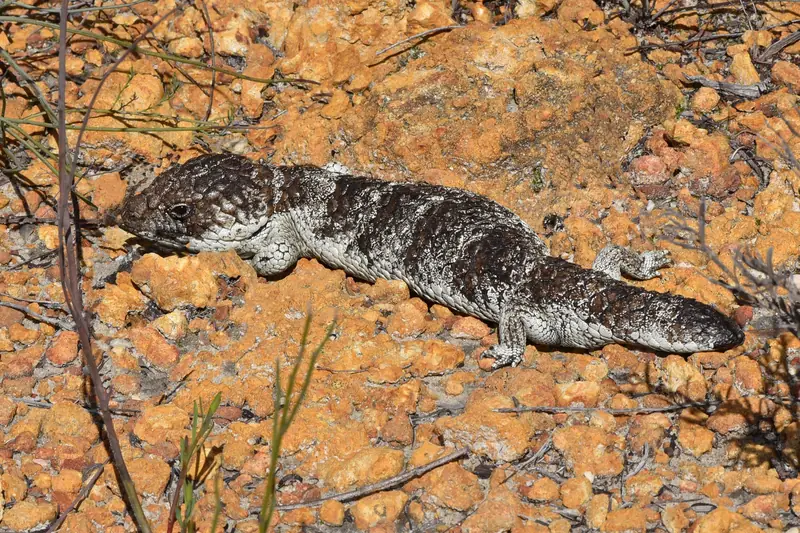
.jpg)
- Size
- Up to 41 cm nose to tail tip, 34 cm of it head and body. Newborns are up to 22 cm. Australian Museum An adult is up to 41 centimetres long, longer than an A4 page (29.7 centimetres). A newborn is up to 22 centimetres.
- Out
- By daybasking in the early morning, then foraging in the warmer part of the day. At night it shelters in leaf litter or under logs and rocks. Australian Museum
- Eats
- Snails, flowers and berriesmore plants than other blue-tongues eat Australian Museum Dubas and Bull 1991
- In WA
- Protectedlike all native animals DBCA. The Rottnest Island bobtail is listed as vulnerable DBCA, Jul 2026
Bobtail in my yard
or garden? A house guest that brings its own lunch. The best help you can give is room.
- Leave it be. Bobtails aren’t venomous, and reptiles are usually timid, attacking only when threatened or surprised. DBCA Grab one, though, and a frightened bobtail may bite. Australian Museum
- Keep the cat and dog away from it. Young bobtails are easy prey for suburban dogs and cats, and large dogs kill some adults. Australian Museum Perth Zoo’s fix: make the lizard-friendly corners of your garden off-limits to pets. Perth Zoo
- Don’t feed it. Not even a scrap of mince. Perth Zoo: “It is important not to feed reptiles in your garden.” Perth Zoo In WA it’s an offence to feed native animals without lawful authority. BC Act s 155
- In the house? No drama. DBCA says it can be carefully scooped into a box or bucket with a broom, or gently picked up with a towel or protective gloves, then let go in your backyard. If you’re unsure, ring the Wildcare Helpline on (08) 9474 9055. DBCA
- Hurt or sick? Ring the Wildcare Helpline on (08) 9474 9055, or take it to your closest vet. DBCA Don’t give it food or water. DBCA
Do bobtails hibernate
in winter? Not quite. They lie low. In the cold, bobtails stay put, buried deep in their shelter, but a sunny day may coax one out to bask. Australian Museum Come early spring in the south-west, reptiles get moving, and you’ll see more of them. DBCA
Pairs together Australian Museum
Young born Australian Museum
Most active, one study Firth and Belan 1998
- 2 or 3
- Young in a usual litter, born live, not hatched, three to five months after mating. Australian Museum
- 200 g
- Top weight for a newborn up to 22 cm long. Big babies. Australian Museum
- 27 years
- Loners most of the year, bobtail pairs find each other again every spring. Australian Museum One couple kept that date for 27 years in a long-running study. Bull 2017
What do bobtails eat
in the wild? Snails, flowers and berries, mostly. Bobtails eat more plants than other blue-tongues, and the animals they eat are mostly slow-moving: their jaws crunch through snail shells and beetles. Australian Museum Dubas and Bull 1991 They forage for all of it, so help by growing the menu.
Do
- Plant natives, mixing dense, shady patches with sunny, open ones. Perth Zoo
- Keep a sunny corner of mulch, bark and leaf litter near ground cover: a larder of insects and snails. Perth Zoo
- Give it places to hide: rocks, logs, pipes or bricks with holes. Buy or reuse them; don’t take them from the bush, where someone already lives in them. Perth Zoo
- Leave flat rocks or old roof tiles in the sun for basking. Perth Zoo
- Make the lizard spots somewhere your cat and dog can’t get to. Perth Zoo
Don’t
- Feed it anything: not mince, pet food or fruit. BC Act s 155 Perth Zoo
- Use pest-control pellets or garden chemicals: a poisoned snail or insect makes a sick lizard. Perth Zoo
- Use rat poison if you can avoid it. In Perth, it turned up in 60% of bobtails tested. Lettoof 2020
- Keep a bobtail you’ve found, even for a while, without expert advice. DBCA DBCA
Are bobtails dangerous
to dogs? They aren’t venomous, and the danger mostly runs the other way. A Perth study named dog attacks the biggest threat to bobtails, and private property, yards like yours, the riskiest place to be. DBCA Millsteed 2025
- 30–40%
- Of bobtails a Perth wildlife centre took in over five years had puncture wounds, mostly from dogs. Millsteed 2025
- 68%
- Of the bobtails in that study were rescued on private property. Fewer than half of the injured ones had a good outcome. Millsteed 2025
- 60%
- Of bobtails tested in Perth had rat poison in the liver. Lettoof 2020
- If a bobtail bites. A cornered bobtail turns to face the threat, gapes wide and flashes its blue tongue, then may hiss and flatten itself. An adult’s bite can hurt, break the skin and leave a bruise, but there’s no venom. Australian Museum If your dog has been bitten, ring your vet.
- Dogs and cats. Young bobtails are easy prey for suburban dogs and cats, and large dogs kill some adults. Australian Museum Keep the lizard-friendly parts of the garden out of your pets’ reach. Perth Zoo
- Mowers, trimmers and cars. Knocks from cars and garden equipment made up 16 to 24% of those Perth admissions. Millsteed 2025 Check long grass and garden beds before you mow or trim, and watch the road in spring: from September to November, pairs are together and often seen crossing. Australian Museum
- Poison. Lizards can get sick from eating snails and insects that have taken pest-control pellets Perth Zoo, and rat poison turns up in Perth bobtails. Lettoof 2020 Our rat poison guide has ways to beat rats without it.
Bobtail lizard rescue
starts with a phone call. If a bobtail is hurt or sick, ring the Wildcare Helpline, or take it to your closest vet. DBCA
- Ring first. The Wildcare Helpline gives advice on sick and injured native animals and can refer you to wildlife carers. It can’t come out to rescues, and it’s run by volunteers, so be patient. DBCA
- If you’re told to bring it in, cover it with a towel, gently pick it up and put it in a ventilated box of the right size. Keep it warm, dark and quiet. DBCA Use gloves or a towel: hurt or frightened reptiles may scratch and bite, and can carry viruses and bacteria. DBCA
- No food or water. DBCA says it may delay treatment and could harm the animal’s recovery. DBCA
- Runny eyes or nose? Perth wildlife carers see a breathing illness in bobtails, known as bobtail flu. Signs include extra mucus in the mouth, sneezing, discharge from the eyes and nose, tiredness and weight loss. A virus has been linked to it, but not yet shown to cause it. O’Dea 2016 Don’t try to treat it yourself: ring the helpline or a vet. DBCA
- It isn’t yours to keep. You may rescue a hurt animal and care for it for a short time, but within 72 hours it has to go to a vet, a licensed wildlife carer or a wildlife officer, or back where you found it if it can fend for itself. BC Act s 161 BC Regs reg 126
Our reading of the Act and Regulations, not legal advice.
Can you keep blue tongue lizards
as pets? Not one from the wild, ever. These are the questions people search most, each answered in its first line.
Can I keep a bobtail I found?
No. DBCA: “Under no circumstances can a reptile that has been found in the wild be kept as a pet.” In WA you need a licence to keep pet reptiles; bobtails bred in captivity are on DBCA’s list for a standard pet keeper’s licence. DBCA DBCA pet list
The Act says a person must not possess fauna without lawful authority, with a maximum fine of $50,000 for an animal that isn’t threatened, and an infringement notice of $2,500 for an individual. BC Act s 152 BC Regs Sch 9
Our reading of the Act, not legal advice.
Can you relocate a bobtail?
Only out of the house and back into your yard. That’s DBCA’s advice for a bobtail indoors. DBCA Don’t drive it across town. The regulations let a person take a reptile from in or near a house without a licence if it’s dangerous or likely to come to harm, but it must be let go within 6 hours in a place where bobtails are normally found in the wild, or one a wildlife officer approves. BC Regs reg 47 If you’re not sure, ring the Wildcare Helpline on (08) 9474 9055. DBCA
Our reading of the Regulations, not legal advice.
Do bobtail lizards bite?
Yes, if frightened or picked up, but they aren’t venomous. An adult’s bite can hurt, break the skin and bruise, but you usually get fair warning: a gape, a flash of blue tongue and a hiss. Australian Museum DBCA
Do bobtail lizards lay eggs?
No. They give birth to live young. The young grow inside the mother with the help of a placenta, and are born three to five months after mating, between December and April. There are usually only two or three, but they’re hefty: each up to 22 cm long and 200 g. Australian Museum
What is bobtail flu?
A breathing illness seen in wild bobtails around Perth. Signs include extra mucus in the mouth, sneezing, discharge from the eyes and nose, tiredness and weight loss. A 2016 study of bobtails taken in by a Perth wildlife centre found a new virus in 41% of sick bobtails and 12% of healthy ones. The authors say more work is needed to show whether it causes the illness. O’Dea 2016 If you see a bobtail with these signs, ring the Wildcare Helpline on (08) 9474 9055 or take it to a vet. DBCA
How long do bobtails live?
A long time: perhaps 50 years or more. That’s an estimate from researchers who’ve followed sleepy lizards for decades; they say the study hasn’t run long enough to be sure. Flinders University In the same work, one pair reunited every spring for 27 years. Now that’s commitment. Bull 2017
Are bobtails and blue tongues the same?
A bobtail is one kind of blue-tongue. Blue-tongues and bobtails (shinglebacks) are all Tiliqua lizards, with big heads, sturdy bodies and dark blue tongues. DBCA The bobtail, Tiliqua rugosa, is the one with the short, stumpy tail; it’s also called the shingleback, sleepy lizard and stumpy-tailed lizard. Australian Museum Around Perth you may also see the western blue-tongue, a different species. Perth Zoo
Do bobtails keep snakes away?
Nice idea, but there’s no evidence they do. Ecologists call it an old wives’ tale: there is “no evidence blue-tongue lizards prey upon or scare brown snakes”. The Conversation It’s closer to the reverse: large snakes are among bobtails’ predators. Australian Museum For snakes in the yard, ring the Wildcare Helpline on (08) 9474 9055. DBCA
Is it illegal to feed bobtails in WA?
Yes, unless you have lawful authority. Section 155 of the Biodiversity Conservation Act 2016 says: “A person must not feed fauna unless the person has lawful authority to feed it.” The maximum fine is $20,000, and an infringement notice for an individual is $400. BC Act s 155 BC Regs Sch 9 DBCA says the same in plain English. DBCA
Our reading of the Act, not legal advice.
Sources, checked 9 October 2026
- Fauna Notes: Reptiles in and around the house DBCA fact sheet (2017; DBCA’s list shows 30 Jun 2023): bobtails non-venomous; protected; reptiles move around more in early spring in the south-west; a bobtail in the house; a wild reptile can’t be kept as a pet; sick or injured reptiles; the helpline number
- Wildcare Helpline DBCA: what the helpline can and can’t do; how to contain a hurt animal; no food or water; don’t keep wildlife without expert advice
- Biodiversity Conservation Act 2016 (WA), s 152, s 155, s 161 as at 25 Sep 2025: possessing fauna; feeding fauna; caring for injured fauna
- Biodiversity Conservation Regulations 2018 (WA), regs 47 and 126, Schedule 9 as at 31 Mar 2025: reptiles at houses; the 72-hour rule for injured fauna; infringement amounts
- Pet keeper’s species list (Appendix 1 to the CEO guidelines) DBCA: bobtail, Tiliqua rugosa rugosa, is a Category B (standard licence) species
- Supporting wildlife in urban areas DBCA: “It is therefore an offence to feed wildlife without lawful authority.”
- Shingleback lizard Australian Museum, updated 21 Apr 2026: size; diet; daily and cold-weather habits; defence and bite; live young, litter size and birth months; pairs; predators
- Reptile-friendly garden Perth Zoo (no date shown): don’t feed reptiles; plants, shelter, basking spots, leaf litter, water; keep pets away; avoid chemicals and pest-control pellets
- Threatened and Priority Fauna List, July 2026 DBCA, updated 31 Jul 2026: Rottnest Island bobtail, T. r. konowi, vulnerable; the mainland bobtail is not listed
- Dubas and Bull 1991, diet of the sleepy lizard Wildlife Research 18: a diet of mainly flowers and berries, and the introduced land snail
- Firth and Belan 1998, sleepy lizard activity Physiological Zoology 71(3): 303–311 (abstract): “most active in late winter-spring (August-November)”; in late spring and summer, mostly early morning
- Lettoof and others 2020, “Toxic time bombs” Science of the Total Environment 724, Perth: rat poison in 60% of bobtails tested
- O’Dea and others 2016, a new nidovirus in wild shingleback lizards PLoS ONE 11(11): e0165209. Bobtails at Kanyana, Perth, Apr to Dec 2015: “bobtail flu” signs; virus in 41% of cases and 12% of healthy lizards; cause not yet shown
- Millsteed 2025, human activity and bobtails in Perth Murdoch University honours thesis, five years of Kanyana admissions: dog attacks the biggest threat (30 to 40%); cars and garden equipment 16 to 24%; 68% rescued on private property
- Bull and others 2017, “Why is social behavior rare in reptiles? Lessons from sleepy lizards” Advances in the Study of Behavior 49: pairs reform each spring for up to 27 years
- Cold-blooded facts of life Flinders University news, 24 Jun 2022, on Reinke and others 2022, Science (doi 10.1126/science.abm0151): sleepy lizards may live 50 years or more, an estimate
- Does Australia really have the deadliest snakes? We debunk 6 common myths The Conversation, 29 Sep 2020, by Charles Sturt University ecologists: “no evidence blue-tongue lizards prey upon or scare brown snakes”
Where sources differ, we give the Western Australian one, and say where a figure comes from a study outside WA.