Guides Western grey kangaroo
Out to graze: late afternoon to early morning DBCA
Kangaroos in your garden
Enjoy them from a distance, never feed them, and fence the seedlings you’d hate to lose. Feeding native wildlife without lawful authority is an offence in WA, and kangaroos usually slip under a fence, not over it. BC Act s 155 DBCA DBCA fence note
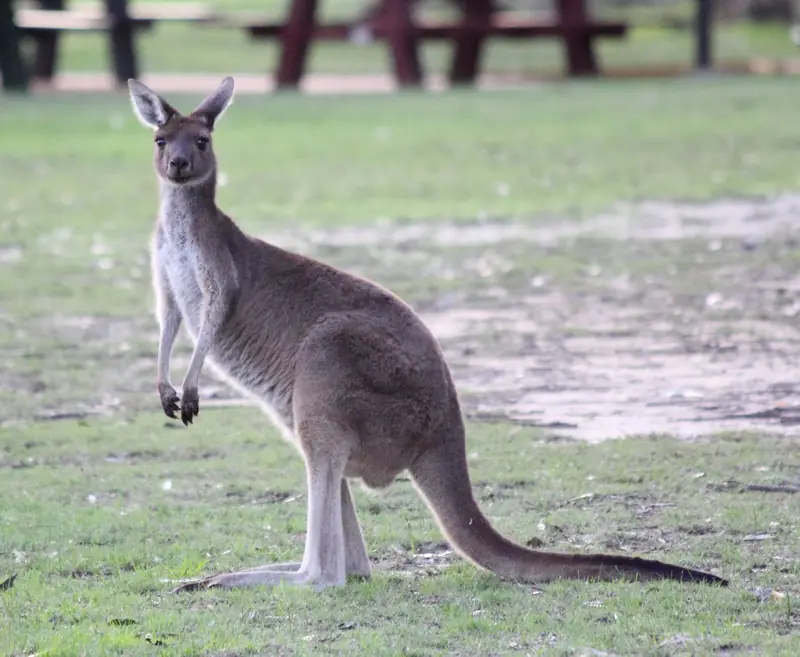

- Size
- Up to 2.2 m 97 to 223 cm from head to tail tip, and 3 to 70 kg. Females weigh up to 34 kg. DBCA From 97 to 223 centimetres long, head to tail tip.
- Out
- Late afternoon to early morningresting in the shade by day DBCA
- Eats
- Grasses and herbsand browse from native shrubs in forest and woodland DBCA
- In WA
- Protectedlike all native animals DBCA
Kangaroo eating my garden
again? Guard the plants it loves, make the yard less of a paddock, and let the kangaroo be. Where new suburbs meet the bush, DBCA says kangaroos sometimes damage gardens and lawns. DBCA
- Fence what you’d miss. In a Perth study, fencing beat everything else for protecting the plants kangaroos like, at least until those plants were big and tough enough. Rafferty and Lamont Victoria’s wildlife agency agrees: fence the plants they like to eat. Vic DEECA
- Build it for how they really cross. Forget the big leap: kangaroos usually crawl through the lower wires or dig under, and jumping over is their least favourite. A fence they can’t see won’t work. DBCA More below.
- Shrink the lawn, skip the water. Keep grassed areas small and don’t provide food or water points, says DBCA’s note for landholders. DBCA Queensland adds: mow regularly to keep grass short. Qld Government
- Never feed them, however hopeful they look. It’s an offence in WA without lawful authority, and DBCA says fed animals can come to rely on handouts, which can make them aggressive. BC Act s 155 DBCA
- Give them room, and keep the dog away. Dogs can chase or stress kangaroos, which can injure or kill both animals. Vic DEECA A hurt kangaroo is a job for the helpline, not you. DBCA
Plants kangaroos won’t eat
don’t exist, as far as anyone’s found. But some get eaten far less than others. After a bushfire at Whiteman Park in Perth, researchers planted 19 local species, then let the kangaroos in. Rafferty and Lamont
Seedlings eaten once kangaroos had access Whiteman Park, Perth, after the February 2001 fire
Harsh hakea Hakea prostrata
13%Marri Corymbia calophylla
22%Prickly Moses Acacia pulchella
42%Candle banksia Banksia attenuata
45%Firewood banksia Banksia menziesii
47%One-sided bottlebrush Calothamnus quadrifidus
61%A bottlebrush Calothamnus sanguineus
63%Sheoak Allocasuarina fraseriana
71%Winged wattle Acacia alata
81%A mirbelia Mirbelia dilatata
86%A bossiaea Bossiaea eriocarpa
90%Native wisteria Hardenbergia comptoniana
97%Balga (grass tree) Xanthorrhoea preissii
98%A grass tree Xanthorrhoea gracilis
98%Red and green kangaroo paw Anigozanthos manglesii
100%Wallaby grass Notodanthonia caespitosa
100%A sedge Cyathochaeta avenacea
100%A globe-pea Sphaerolobium vimineum
100%A native pea Oxylobium lanceolatum
100%
- Prickles didn’t save seedlings. Young spines were too soft, or the kangaroos ate around them, and a prickly “nurse” shrub planted beside a favourite didn’t stop it being eaten. Rafferty and Lamont A peer-reviewed study at the same park found spines and tannins made no clear difference to what was eaten. Rafferty and Lamont 2005 Victoria’s agency does suggest prickly native shrubs, so the advice differs. Vic DEECA
- Soft, grass-like plants go first. Grasses and grass-like plants were favourites, and, fittingly, every kangaroo paw was eaten. Rafferty and Lamont Rafferty and Lamont 2005
- The eucalypt family was mostly left alone, and kangaroos were never once seen eating marri or jarrah in the park. Rafferty and Lamont 2005 Don’t trust the family name, though: bottlebrush seedlings, from the same family, were still eaten. Rafferty and Lamont
- Guard young plants. Kangaroos yanked whole seedlings out of the soil, and plastic sleeves gave only very limited protection. Rafferty and Lamont
- The best-grown plant gets noticed. At Perth Zoo, kangaroos picked plants by size, not nutrient content, and lingered longer at those given more fertiliser, which had grown bigger. Rafferty and Lamont 2006
How to keep kangaroos out
of a garden? Build for the way they cross: usually under, not over. DBCA’s fencing note was written for farms in 2009, but a kangaroo tackles your back fence the same way. DBCA
-
The usual way in. Plain wire is easier to squeeze through than ringlock (mesh). In vineyards, 2 m ringlock deer fencing with well-strained bottom wires is reported to keep kangaroos out. DBCA
-
Yes, they dig. The sloping electric fence DBCA describes keeps its bottom wire 75 to 125 mm off the ground: coffee-mug height. DBCA
-
Their least favourite, for all the spring in those legs. They launch from hard against the fence, so DBCA’s farm designs lean it about 45° away from them, and its most detailed design is 1.8 m high. DBCA For homes, Queensland suggests about 1.5 m, with a gate so animals can leave easily, and says fencing usually works only against smaller kangaroos. Qld Government
- Tap a route to pick it out on the drawing.
- Seen
- If they can’t see it, it won’t work, however clever the design. DBCA
- Dawn, dusk
- Rush hour, when fences take the most damage as kangaroos try to get through. DBCA
- Ask first
- Some local laws ban electric boundary fences, so check with your council. Queensland notes some estates don’t allow fencing. DBCA Qld Government
Can you feed kangaroos
in WA? No, not even a carrot. It’s an offence without lawful authority, and DBCA says handouts can leave animals sick, reliant on people and, in some cases, aggressive. BC Act s 155 DBCA
Do
- Watch from a distance; dawn and dusk are prime time. Vic DEECA
- Keep an eye on kids when kangaroos are about. Vic DEECA
- Keep dogs away from them. Vic DEECA
- Slow down near animals by the road, particularly at dawn and dusk, and be ready to stop. Main Roads
- Fence the plants you’d miss. Rafferty and Lamont
Don’t
- Feed them anything. Not bread, carrots, hay or pellets. BC Act s 155
- Leave out food or water for them. Qld Government DBCA
- Bribe them closer with food for a photo. DBCA
- Swerve around an animal on the road. Main Roads Road Safety Commission
- Chase them, near a fence or anywhere: chased kangaroos can get tangled in fences. Victoria says not to harass or shoo them. DBCA Vic DEECA
Injured kangaroo? Who to call
first: DBCA’s Wildcare Helpline. Volunteers answer, give advice and can put you in touch with your nearest registered wildlife rehabilitator. DBCA
Wildcare Helpline, WA
(08) 9474 9055DBCA doesn’t publish its opening hours. The helpline gives advice; it doesn’t attend rescues. DBCA
Perth, daytime: WA Wildlife (08) 9417 7105. Its ambulance can attempt a rescue of a badly hurt kangaroo in the Perth metro area during the day. After hours: WA Wildlife says to ring your local police station (not 000) for an injured kangaroo. WA Wildlife
On a road, police (131 444) or Main Roads (138 138) can help with the hazard. DBCA
What to do while you wait
- Keep yourself safe. Don’t walk onto a busy road. Kangaroos have a strong kick and sharp claws, and an adult can break bones. DBCA WA Wildlife
- Don’t approach or try to catch it. Chasing an injured kangaroo can make its injuries worse. DBCA
- Keep people and pets back, and watch from a distance. Stay calm, speak softly and move slowly. DBCA
- Ring the helpline, and check the area for young nearby. DBCA
- Found a joey on its own? Wrap it up to keep it warm and ring the helpline for advice. DBCA
A joey in the pouch of a dead kangaroo
Only stop where it’s safe, off the road. DBCA WA Wildlife asks people to check the pouch of a female that has been killed. WA Wildlife
- Ring for help straight away: the Wildcare Helpline on (08) 9474 9055, and follow what they tell you. DBCA
- If the joey is attached to a teat, don’t pull it off. WA Wildlife’s page explains what to do next. WA Wildlife
- Keep it wrapped and warm, and get it to a licensed wildlife rehabilitator as soon as possible. DBCA WA Wildlife
- No milk or drinks unless a carer tells you to. Joeys can choke on fluids given the wrong way, and the wrong milk can quickly cause life-threatening gut problems. DBCA WA Wildlife
The law: anyone may rescue an injured or orphaned native animal and take it to someone allowed to care for it. Within 72 hours it must go to a vet, a licensed carer or a wildlife officer, unless it can fend for itself and goes back where it was found. BC Act s 161 BC Regs r 126
Our reading of the Act, not legal advice.
Kangaroo in my backyard
and wondering what’s allowed? Here are the most-searched questions, each answered in its first line.
Is it illegal to feed kangaroos in WA?
Yes, unless you have lawful authority. Section 155 of the Biodiversity Conservation Act 2016 says: “A person must not feed fauna unless the person has lawful authority to feed it.” The maximum fine is $20,000, and an infringement notice for an individual is $400. DBCA says the same in plain English. BC Act s 155 BC Regs Sch 9 DBCA
The neighbours won’t thank you either: DBCA warns feeding can draw in kangaroos that seriously damage surrounding land. DBCA
Our reading of the Act, not legal advice.
Am I “feeding” kangaroos if they eat my garden?
Not on our reading of the rules. The regulations allow, without a licence, feeding that “involves planted vegetation that does not naturally occur in the fauna’s environment”, and feeding that is accidental or incidental to another lawful activity, can’t be avoided and isn’t likely to harm the animal. Putting food out on purpose is different. If you’re unsure, ask DBCA. BC Regs r 51
Our reading of the regulations, not legal advice.
How do I get rid of kangaroos in my garden?
Not by removing them yourself: make the garden less inviting and fence what matters. Kangaroos are protected native animals. DBCA The regulations’ own rule on taking western grey kangaroos covers only those damaging “an agricultural activity”, in listed shires, under a national code of practice; a home garden isn’t mentioned. A DBCA licence can allow animals that cause damage to be taken or disturbed, by the licence holder. BC Regs r 104, r 29 DBCA licences
For advice, ring DBCA’s Wildlife Licensing Section on (08) 9219 9000 and choose the Wildlife Licensing option. DBCA
Our reading of the regulations, not legal advice.
What vegetables do kangaroos eat?
We haven’t found a study of kangaroos in home veggie patches. On farms, DBCA’s damage list runs from lupins, barley, wheat and oats to grapevines, fruit, tree seedlings and flower crops, mostly in late autumn and early winter, when green feed is scarce elsewhere. DBCA Assume your veggie patch is on the menu, and fence it. Vic DEECA
What do you do if you see a kangaroo?
Keep your distance and let it be. Attacks are rare, but kangaroos can hurt people if they feel threatened, are protecting young or are startled. Vic DEECA Qld Government
Move away if you see warning signs: walking slowly on all fours with its back arched, growling, clucking or coughing, thumping with its tail or feet, standing tall, or rubbing its chest on the ground or plants. Vic DEECA Qld Government
Sources, checked 9 October 2026
- Wildcare Helpline DBCA (no update date shown): injured kangaroos; young nearby; road hazards (police 131 444, Main Roads 138 138); the helpline number; it gives advice and doesn’t attend rescues; no food or water unless a rehabilitator advises
- Found an injured animal? WA Wildlife, which runs the helpline for DBCA (no date shown): adult kangaroos; the daytime Perth ambulance; local police after hours; the steps for a joey in a dead mother’s pouch; fluids and milk
- Fauna Note 29: Western grey kangaroo DBCA (then DEC), last updated 25 June 2009: size and weight; diet; grazes late afternoon to early morning; garden damage near bush; farm damage most likely in late autumn and early winter; keep grassed areas small and don’t provide food or water. Its legal and shooting sections cite a repealed Act, so we don’t use them
- Fauna Note 32: Fencing and gates to reduce kangaroo damage DBCA (then DEC), last updated 25 June 2009, written for farms: crawl through or dig under, jump least; visibility; sunrise and sunset; tangling when chased; 45° sloped and 1.8 m electric designs; 2 m deer fencing in vineyards; local laws on electric fences
- Biodiversity Conservation Act 2016 (WA), s 155 and s 161 as at 25 Sep 2025: feeding fauna; injured or abandoned fauna
- Biodiversity Conservation Regulations 2018 (WA) as at 31 Mar 2025: r 29 (fauna causing damage licence), r 51 (authorised feeding), r 104 and Schedule 4 (kangaroos as managed fauna), r 126 (72 hours), Schedule 9 (infringement amounts)
- Supporting wildlife in urban areas DBCA: “Feeding wildlife is illegal without an authority”; feeding can attract kangaroos that damage surrounding land
- Public urged not to feed native wildlife DBCA news, 4 July 2023: people using food to get closer to kangaroos for photos; reliance on being fed can lead to aggression; feeding can make animals sick
- Living with native wildlife DBCA: all native fauna is protected under State and Commonwealth law. DBCA has no current fact sheet on kangaroos in gardens
- Rafferty and Lamont, Kangaroo grazing preferences after fire at Whiteman Park Western Wildlife 10(2), the Land for Wildlife newsletter, held by DBCA’s library (issue date not printed on the page): the 19-species table; spines; nurse plants; plastic sleeves; fencing
- Rafferty and Lamont 2005, Selective feeding by macropods on vegetation regenerating following fire Journal of the Royal Society of Western Australia 88: 155–165, peer reviewed: spines and tannins had no clear effect; grass-like plants preferred; Myrtaceae avoided; marri and jarrah never seen eaten
- Rafferty and Lamont 2006, Food choice by western grey kangaroos among plants grown at different nutrient levels Journal of the Royal Society of Western Australia 89: 7–12, peer reviewed, Perth Zoo: choice by plant size; longer feeding at bigger, more fertilised plants
- Living with Wildlife: Kangaroos Victoria’s Department of Energy, Environment and Climate Action, 2023 (mostly about eastern greys): don’t feed; dogs; children; warning signs; don’t harass or shoo; prickly native shrubs; fencing plants they like
- Living with kangaroos and wallabies Queensland Government, updated 3 Jul 2023, reviewed 10 Jun 2024: fence about 1.5 m with a gate; fencing may not be allowed in some estates; mow; limit water; never provide food or water; warning signs
- Regional and long distance driving Main Roads WA (no update date shown): slow down for animals near the road, particularly at dawn and dusk; be ready to stop; avoid swerving
- Visitors to regional WA Road Safety Commission, updated 5 May 2023: kangaroos are unpredictable; don’t try to swerve around an animal
- Fauna licences DBCA: the fauna causing damage licence; Wildlife Licensing Section contacts
This guide is for Western Australia, where the backyard kangaroo is the western grey. Victoria’s and Queensland’s advice is mostly about other kangaroos and other laws; we use it only where DBCA is silent, and say so. DBCA’s two kangaroo notes date from 2009; we use them for how kangaroos live, not for the law.