Guides Quenda
Most often seen: at dawn and dusk
Quenda in your yard
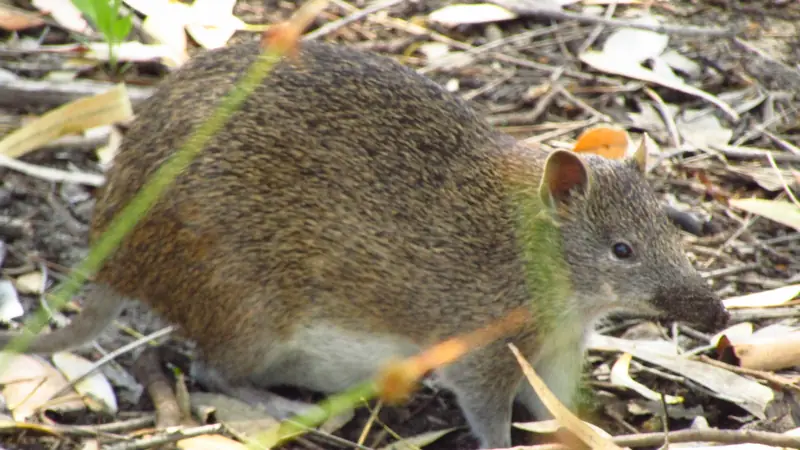
Those little cone-shaped holes? A quenda, hunting grubs. It’s a native bandicoot, protected in WA: leave it be, and don’t feed, trap or move it. DBCA

- Size
- 28 to 36 cm nose to rump, plus a short tail of 9 to 12 cm. Up to 2 kg, about the size of a small rabbit DBCA A quenda’s body is 28 to 36 centimetres long, plus a tail of 9 to 12 centimetres. An A4 page is 29.7 centimetres.
- Out
- Dawn and duskmostly at night, but out by day too, especially in winter DBCA
- Eats
- Grubs, worms and fungiplus beetles, tubers and bulbs, all dug from the soil DBCA
- In WA
- Protectedlike all native animals, and on DBCA’s Priority 4 list, “in need of monitoring” DBCA DBCA, Jul 2026
Bandicoot in my yard?
In south-west WA, that’s a quenda. Let it be, and make your yard safe to visit. DBCA DBCA
- Let it dig. Free lawn care: DBCA says the diggings leave a lawn “aerated and pest-free”. If the holes bug you, press the plugs of grass and soil back in. DBCA
- Keep the cat in, and the dog from roaming. Pet cats and dogs kill quenda. In a 2012 survey, cats, dogs and foxes caused almost a third of the deaths people reported. DBCA DEC 2013
- Give it a way out of the pool. Quenda drown in pools, fish ponds and drains. A pool cover is best. Without one, a brick on the top step may give a quenda the foothold it needs. DEC 2013
- Keep some low, dense shrubs. They’re a quenda’s daytime bedroom, and flowers and greenery bring the beetles, grubs and worms they eat. DBCA
- Don’t feed it. Not fruit, grain or pet food. It can harm their health, and in WA feeding native animals without lawful authority is an offence. DBCA BC Act s 155
- Hurt, or hit by a car? Don’t pick it up: DBCA says only trained, licensed people should handle quenda, and a hurt one may scratch. Ring the Wildcare Helpline on (08) 9474 9055. DBCA DBCA
Bandicoot holes in lawn
are neat little cones: a quenda has been after beetles, grubs, spiders or fungi. A rabbit’s digs are bigger and blunter. DBCA
Quenda
Cone-shaped
Dug for beetles, grubs, spiders and fungi, and only now and then in lawns and beds. DBCA
Rabbit
Larger, blunter, square-ended
Dug for tubers and roots, and usually ringed by small, round droppings. DBCA
Cross-sections drawn from DBCA’s descriptions, not to scale.
- About 45
- Foraging pits one bandicoot dug a day, in a study at Yalgorup National Park, south of Mandurah. Valentine 2013
- 10.7 kg
- Soil shifted a day, by the same study’s estimate: over five times a big quenda’s weight. Valentine 2013
- 3.9 tonnes
- Soil one animal turns over in a year, one little cone at a time, scaled up from those daily figures. The authors call this digging likely “a critical component” of soil processes. Valentine 2013
How to stop bandicoots digging
up the lawn? Fence off the part you care about with a low mesh barrier. Quenda can’t climb, so knee-high does it. DBCA
DBCA’s design: galvanised mesh with holes no larger than 2 cm (aviary wire), buried 15 cm deep and standing 50 cm above the ground, around the garden bed or lawn you want to keep. DBCA
Are quendas endangered
in WA? Not threatened, but watched. DBCA lists them as Priority 4, “in need of monitoring”. In a 2012 survey, cars, pets and pools caused most of the deaths people reported. DBCA, Jul 2026 DEC 2013
Hit by a vehicle mostly cars, some fast bikes
Killed by cats, dogs or foxes “almost a third”
Drowned 62 quenda, in pools, fish ponds and drains
DBCA also names the clearing and break-up of bushland, fire in fragmented bush, foxes and feral cats, and competition from rabbits for food. DBCA DBCA
Is a quenda a bandicoot?
Yes, WA’s own. The other questions people search most, each answered in its first line.
Is a quenda a bandicoot?
Yes, the bandicoot of south-west WA. DBCA also calls it the southwestern brown bandicoot. DBCA For more than 150 years it was counted as a subspecies of the southern brown bandicoot of eastern Australia. Then a 2018 study found it’s a species in its own right, Isoodon fusciventer, and closer to the golden bandicoot. WA Museum Travouillon 2018
Quenda or rat: how can you tell?
A quenda is stouter, with a shorter tail, and it can’t climb. Look for a long, pointed nose, short rounded ears, and coarse grey-brown fur with a creamy belly. DBCA
What do quenda eat?
Can you feed quenda?
No. DBCA says fruit, grain and pet food “can have negative effects on their health”, and that relying on handouts can cut breeding, spread disease, blunt their wariness of predators and bring solitary animals together to fight. DBCA DBCA says people who feed quenda and other animals “have the best intentions”, but it “can be doing more harm than good”. DBCA, 2023
In WA, section 155 of the Biodiversity Conservation Act 2016 says: “A person must not feed fauna unless the person has lawful authority to feed it.” The maximum fine is $20,000. BC Act s 155
Our reading of the Act, not legal advice.
Can you relocate a quenda?
No. DBCA says relocating quenda is “not an appropriate or recommended option”. A moved quenda has to compete with the wildlife already there, and is more likely to be killed by cars, cats, foxes and dogs. DBCA
In WA, the Biodiversity Conservation Act 2016 counts trapping as taking fauna, and taking fauna without lawful authority is an offence, with a maximum fine of $50,000. Releasing fauna without lawful authority is a separate offence, up to $20,000. BC Act ss 5, 149, 162 If a quenda is truly stuck or hurt, ring the Wildcare Helpline on (08) 9474 9055. DBCA
Our reading of the Act, not legal advice.
Will the quenda keep coming back?
Do quendas live in burrows?
Not usually. They nest in a shallow scrape under a shrub, lined with leaves, dry grass and other soft material: more bed than burrow. They sometimes use old rabbit burrows. DBCA
Can quendas climb?
No. That’s DBCA’s easy tell between a quenda and a rat. DBCA
Are quendas dangerous?
Not if you leave them alone. DBCA notes they can carry viruses, like other wildlife, and may scratch when hurt or afraid, so only trained, licensed people should handle them. DBCA A study of 287 quenda around Perth found mostly native parasites that aren’t known to infect people or pets, or are thought highly unlikely to. The authors say a few, including Giardia, Cryptosporidium and Amblyomma ticks, need more study to tell whether they can pass to people. Hillman 2017
Do quendas have a pouch?
Is quenda a Noongar word?
Yes. Early records spell it dozens of ways, among them gwinda and kweenda around the Vasse, near Busselton. A 2001 review of Noongar mammal names recommends kwenda, said KWEN-da. It also gives Quindalup, on Geographe Bay, as one of the south-west’s place names that carry a Noongar name for a mammal. Abbott 2001
Sources, checked 9 October 2026
- Fauna Notes: Living with quenda DBCA fact sheet (2017; DBCA’s download list shows it last updated 1 Mar 2024): size, diet, habits, nests, breeding; lawn digging and the mesh barrier; relocation; handling; protection
- Fauna profile: Quenda DBCA (last updated 8 Feb 2012): home range, seasonal diet, backward-opening pouch, threats including fire in fragmented habitat
- Threatened and Priority Fauna List, July 2026 DBCA: Isoodon fusciventer, quenda, Priority 4 (“Rare, Near Threatened and other species in need of monitoring”). Priority is not a listing under the BC Act
- Biodiversity Conservation Act 2016 (WA), ss 5, 149, 155, 162 as at 25 Sep 2025: “take” includes to capture, and “capture” includes to trap (s 5); taking fauna (s 149); feeding fauna (s 155); releasing fauna (s 162)
- DBCA news: public urged not to feed native wildlife dated 4 July 2023: feeding quenda and other animals can do “more harm than good”
- Wildcare Helpline DBCA: the helpline number, (08) 9474 9055, and what the helpline does
- 2012 Quenda (Bandicoot) Survey newsletter, issue 1 DEC (now DBCA) and WWF-Australia, January 2013: causes of reported deaths; pools; keep cats indoors and dogs from roaming
- Valentine and others 2013, foraging activity by the southern brown bandicoot as a mechanism for soil turnover Australian Journal of Zoology 60(6): about 45 pits and 10.74 kg of soil a day, about 3.9 tonnes a year, at Yalgorup National Park, WA
- New research tracks evolution of bilbies and bandicoots WA Museum, 19 Feb 2018: the quenda is a distinct species, not a subspecies of the southern brown bandicoot
- Travouillon and Phillips 2018, total evidence analysis of the phylogenetic relationships of bandicoots and bilbies Zootaxa 4378(2): the study the WA Museum reports
- Hillman and others 2017, urban environments alter parasite fauna, weight and reproductive activity in the quenda Science of the Total Environment 607–608: 287 quenda sampled in greater Perth
- Abbott 2001, Aboriginal names of mammal species in south-west Western Australia CALMScience 3(4): recorded Noongar names for the quenda, the recommended kwenda [kwen’da], and Quindalup among place names that keep a Noongar mammal name
The quenda used to be named Isoodon obesulus or Isoodon obesulus fusciventer, so sources before 2018, including several above, use those names.